 "You'll probably think I'm making a lot of this up just to make me sound better than I really am or smarter or even luckier but I'm not." Russell Banks's Rule of the Bone, written in 1995, is a 390 page fictitious autobiographical novel. I like this book because it's written in first person, from the point of view of the main character, Chappie. Chappie, later known as Bone, goes through a lot of bad times with family, friends, and strangers. Oddly enough, by the end of the story, it's family, friends, and strangers who end up helping him the most. Chappie is a young kid who runs away from home because of some serious dysfunction and abuse. Working his way south, he hangs out with a biker gang, becomes a petty thief, turns into a caretaker for someone he rescues, and ends up getting into drugs, all on his way from upstate New York to Jamaica. Banks's style is similar to Jack Kerouac's On The Road and J.D. Salinger's The Catcher in the Rye. Readers 14-20 and into music or with a slightly less-than-perfect family life will enjoy this book.
Monday, May 12, 2008
Rule of the Bone
Other Info:

Saturday, May 10, 2008
Into Thin Air
 Imagine you're in an airplane. That's roughly how high Mount Everest rises at the peak. People climb as high as many airplanes fly for fun. Some even do it without oxygen tanks.
Jon Krakauer's Into Thin Air, written in 1997, is a 374-page nonfiction/adventure novel. I like this book because Krakauer's writing is interesting and fun to read, not what I used to think of when I thought about nonfiction. He writes nonfiction, but in a creative way, crafting some of my favorites sentences ever. In some ways, I like his writing even more than my favorite fiction authors. Within the first chapter, a tiny 7-paged thing, there are easily 10 incredible sentences. And his writing stays that good for almost the entire book (there's a part toward the middle describing the history of Mount Everest that's a bit drier than the rest of the novel).
In the Spring of 1996, several different parties paid roughly $50,000 per person for a chance to climb to the summit of Mount Everest, the highest mountain in the world. Weather conditions, some unfortunate decisions, several poorly prepared climbers, and simply too many people on the mountain at once made for one of the worst disasters to happen on Everest. From the beginning of this story, you know things aren't going to work. The fun is not in reading about how things turned out, but about why they turned out that way. You'll both want to blame and forgive just about everyone by the time you finish the last page.
Krakauer's style is similar to a combination of what's written in history books and your favorite short story from English class. Krakauer has some Simon Winchester (The Professor and the Madman) and Piers Paul Read (Alive) to him, but I probably only think that because of my limited exposure to nonfiction. Readers over 14 years old and into hiking, camping, climbing, the outdoors, or sports will enjoy this book.
Other Info:
Friday, May 9, 2008
Haroun and the Sea of Stories
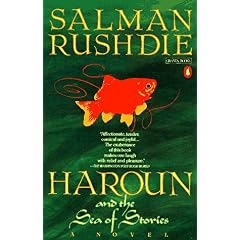 All the stories have gone away. Not only have people stopped telling them, but the sea of stories is getting polluted, in a way. All the stories are mixing up and making the waters impossible to use. How important are stories to us? Aren't they just things to waste time? They aren't really necessary, are they?
Salman Rushdie's Haroun and the Sea of Stories, written in 1990, is a 211-page fantasy novel. I like this book because of the way it describes stories, as if they are actual things you can touch. Also, the idea that stories are useful for more than just having fun becomes clear when Rushdie describes a world without any stories. Why bother to tell stories about things that aren't true? Because things look pretty sad and boring without them.
Set in the sad, sad city of Alifbay, Haroun realizes something is wrong. One day, his mother stops singing in mid song. Another day, he asks one too many questions. Finally, on yet another day, his father's supply of Story Water is cut off. The stories have all stopped and Haroun must fix the mistake, bringing stories back to the world. Water Genies, mail delivery, Gup City, princes, and generals all lead Haroun toward the Sea of Stories.
Salman Rushdie's style is similar to Lewis Carroll's Alice in Wonderland and Jean Ferris's Love Among the Walnuts. There's even a bit of a more grown-up Lemony Snicket (A Series of Unfortunate Events) here. Readers 15 years old and up will enjoy this book.
Other Info: